

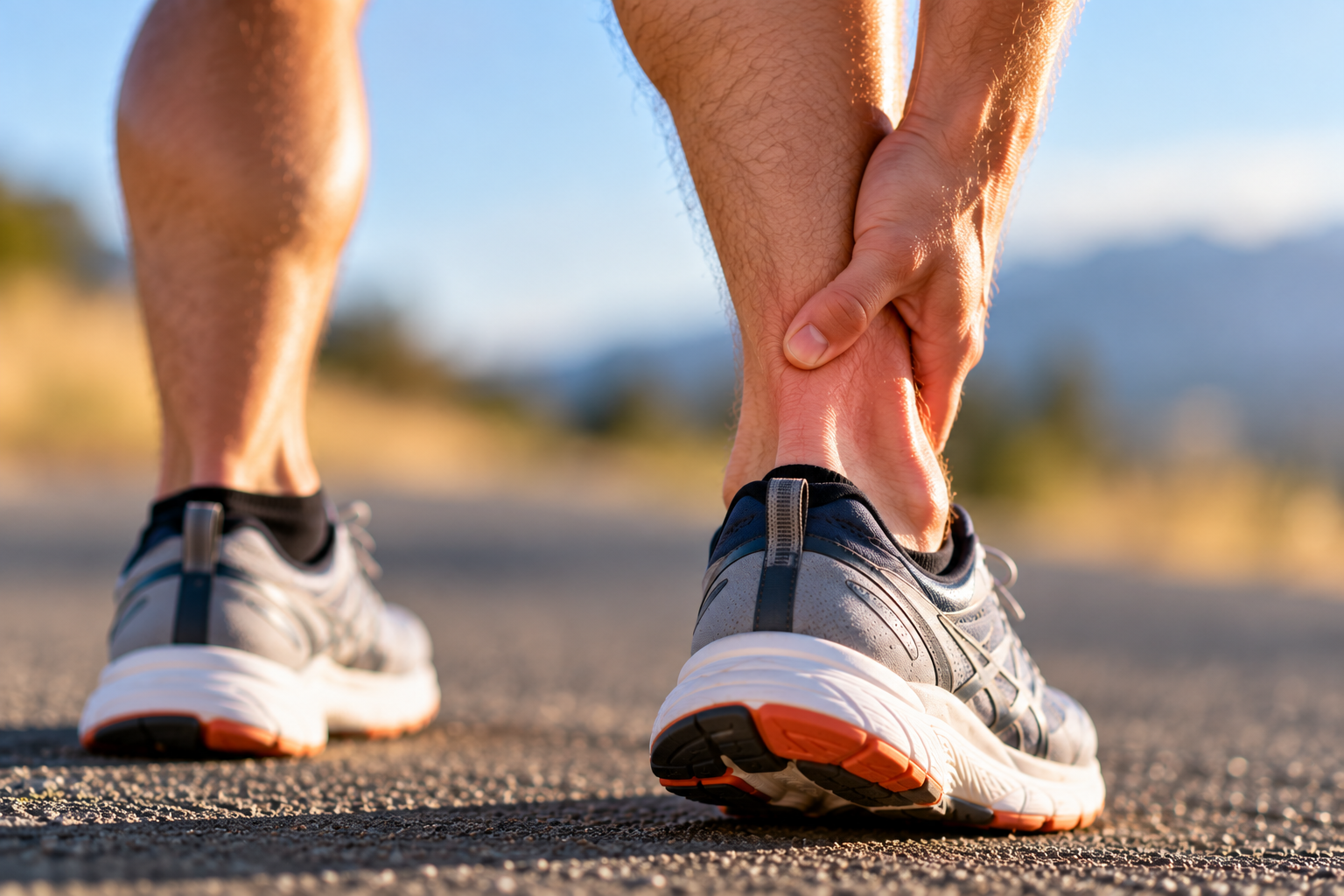
Achilles pain can be one of the more frustrating problems for runners.
Sometimes it feels stiff for the first few minutes of a run and then improves. Other times it feels fine while you're running but becomes sore later that day or the next morning.
And because you may still be able to run, it can be difficult to know how seriously to take it.
The Achilles tendon is built to handle a tremendous amount of load. Every time you run, your calf and Achilles complex plays a major role in managing the forces your body experiences when your foot hits the ground.
But like other tissues in the body, the amount of load the Achilles can tolerate isn't unlimited.
When the demands of training and the capacity of the tendon get out of balance, symptoms can develop.
Where Is Your Achilles Pain?
Not all pain around the back of the ankle is exactly the same.
Some runners experience pain several centimeters above the heel.
Others experience symptoms where the Achilles attaches directly to the heel bone.
And pain around the back of the ankle isn't always coming from the Achilles tendon in the first place.
The location of your symptoms is one piece of information that can help determine what's actually irritated.
This becomes especially important when we start talking about things like stretching and exercise selection because where the Achilles hurts can change how I approach it.
Why Does Achilles Pain Sometimes Get Better While Running?
This can be confusing.
You wake up with a stiff or sore Achilles, start your run, and after warming up it actually feels better.
It can be tempting to assume that means everything is fine.
But how something feels during a run is only part of the picture.
I also want to know what happens afterward.
Does the Achilles become more painful later that day?
Is it more sensitive the following morning?
Is your morning stiffness lasting longer?
Are symptoms beginning earlier in each run?
A tendon feeling better once it's warmed up doesn't necessarily tell us how well it tolerated the entire training session.
What Usually Changes Before Achilles Pain Starts?
When evaluating a runner with Achilles pain, one of the biggest questions is:
What changed?
It may not be mileage.
Changes that can increase demand on the calf and Achilles include:
Increasing running volume
Adding speed work
Running more hills
Increasing the length of the long run
Adding more running days
Returning after time away
Changing shoes
Changing running mechanics
Adding jumping, plyometrics, or additional strength training
Sometimes several of these happen at once.
A runner might maintain roughly the same weekly mileage but start preparing for a race and add hills and intervals.
The mileage looks similar.
The demand on the Achilles may not be.
Hills and Speed Can Matter
The calf and Achilles are some of the hardest-working structures in running.
Increasing your speed, adding hills, or changing the type of workouts you're doing can significantly change the demands placed on them even if your weekly mileage stays about the same.
This is why I don't look only at someone's total weekly mileage.
A week of easy running isn't necessarily equivalent to the same mileage containing hard intervals and hill repeats.
Intensity matters.
When Achilles symptoms appear, understanding what the runner has actually been doing is often more useful than simply asking how many miles they ran.
Your Calves Do a Lot More Than Push You Forward
The calf is one of the hardest-working muscle groups during running.
It's easy to think of the calf primarily as a muscle that pushes you off the ground.
That's only part of its job.
From the time your foot contacts the ground, the calf-Achilles complex plays a major role in controlling and supporting your body as you move over your foot.
As you progress through stance, the calf and Achilles help manage the forces going through the ankle, control forward movement of the lower leg, store and return energy, and contribute to force production later in the stride.
In other words, the calf isn't simply turning on at the end of your stride to push you forward.
It's working through a large portion of the time your foot is on the ground.
Multiply that by thousands of steps during a run, and you can see why the calf and Achilles need a significant amount of capacity.
Should You Stretch an Achilles That Hurts?
Stretching is one of the first things many runners try when their Achilles starts hurting.
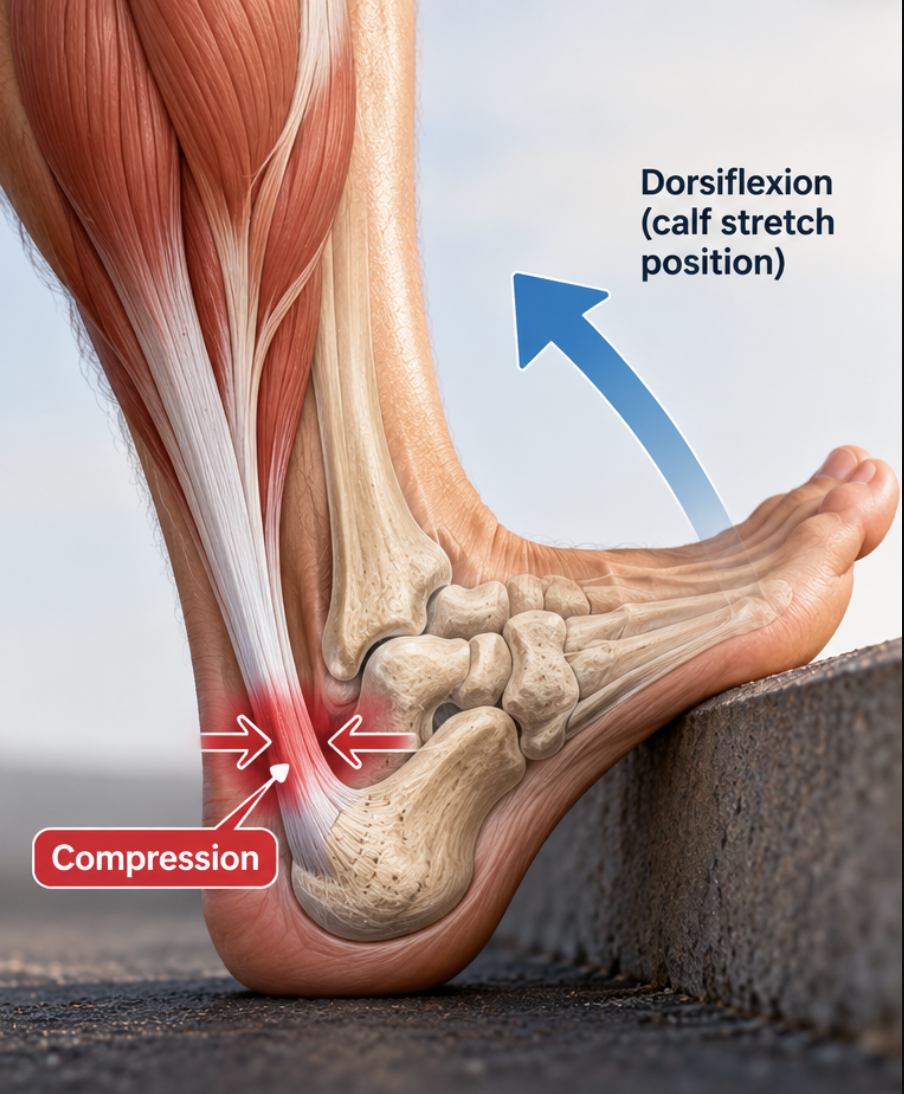
I generally don't automatically recommend stretching an irritated Achilles, particularly when the pain is located where the tendon attaches to the back of the heel.
When you bring your ankle farther into dorsiflexion—such as during a traditional calf stretch—the Achilles compresses against the bone which is often the irritating motion that you feel during running.
If that area is already irritated, increasing compression can make symptoms worse rather than better.
That doesn't mean ankle mobility never matters or that stretching is inappropriate for every runner with Achilles pain.
It means Achilles pain isn't automatically a flexibility problem, and stretching shouldn't automatically be the solution.
Calf Strength Matters for Runners
If the calf-Achilles complex doesn't have the capacity that running demands its an easy way to bring on pain.
That's one reason strengthening is commonly involved in Achilles rehabilitation.
But simply doing a few easy calf raises isn't necessarily enough.
The goal isn't just to be able to perform a calf raise.
The goal is eventually to develop enough strength and capacity to tolerate thousands of repeated loading cycles while running.
That may require progressing resistance, volume, speed, range of motion, and eventually more running-specific demands depending on the runner.
Someone trying to return to high-mileage marathon training has a very different end goal than someone trying to comfortably jog a few miles each week.
Rehabilitation should eventually reflect those demands.
Do You Have to Stop Running With Achilles Pain?
Not necessarily.
Whether running should continue depends on the individual situation.
For some Achilles problems, running can remain part of rehabilitation while training is modified and the tendon is progressively strengthened.
In other situations, running may need to be significantly reduced or temporarily stopped.
The important question isn't simply:
“Does it hurt?”
It's also:
“How is the tendon responding to the amount of running you're currently doing?”
Pain that progressively worsens during runs, significantly changes your mechanics, or continues worsening afterward deserves more attention than symptoms that remain stable and return to baseline.
There are also conditions around the Achilles that require different management, which is why persistent or concerning symptoms should be properly evaluated.
Complete Rest Isn't Always the Long-Term Answer
Taking time off may make an irritated Achilles feel better because you've removed much of the load.
But eventually, running requires the tendon to tolerate load again.
If the only strategy is waiting until the pain disappears and then immediately returning to your previous training, you may end up in a cycle of:
Run → pain → rest → feel better → return to running → pain again.
The long-term goal is usually bigger than getting the tendon to stop hurting.
It's rebuilding enough capacity to tolerate the running you want to do.
Achilles Rehab Should Eventually Look Like the Demands of Running
Early rehabilitation and running don't look very similar.
But as rehabilitation progresses, the gap between the two should narrow.
That may involve progressively heavier strengthening, single-leg work, faster movements, hopping or jumping when appropriate, and eventually running-specific loading.
The exact progression depends on the runner and the injury.
The important part is that rehabilitation progresses with you.
If your exercises never become more difficult while your goal is to return to increasingly difficult running, there's eventually going to be a mismatch.
Achilles Pain While Running?
If Achilles pain keeps interfering with your training, simply resting and hoping it disappears may not address why it keeps returning.
At Stride Running PT, I work one-on-one with runners to evaluate the injury, assess strength and movement, understand the training that led up to the problem, and progressively rebuild toward the running you want to do.
And because Stride Running PT is mobile, I come to you.
Explore Physical Therapy at Stride Running PT to learn more.
Disclaimer: This article is for educational purposes only and is not intended to provide medical advice, diagnosis, treatment, or individualized recommendations. Pain around the Achilles can have multiple causes, and appropriate management varies depending on the condition and individual.