


If you've ever developed pain on the outside of your knee while running, you may have heard someone mention your IT band.
IT band syndrome is a common cause of lateral knee pain in runners, particularly when increasing training or returning to running after time away.
But one of the biggest misconceptions about IT band pain is that the band itself is simply too tight and needs to be stretched.
The reality is more complicated.
What Is the IT Band?
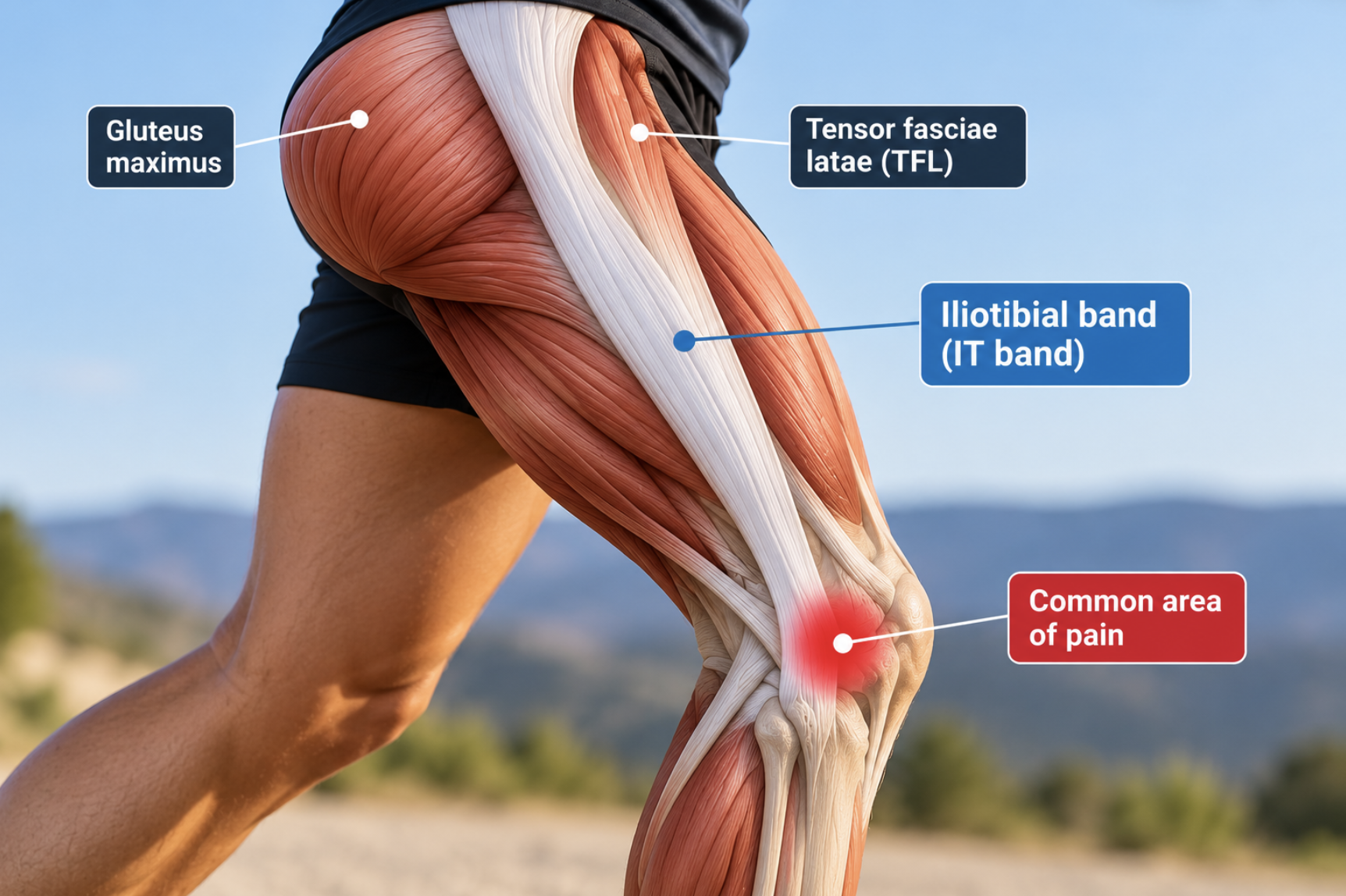
The iliotibial band, commonly called the IT band, is a thick band of connective tissue that runs along the outside of your thigh from the hip to just below the knee.
It connects with muscles around your hip, including the tensor fasciae latae and gluteus maximus, and helps transmit forces and provide stability during movement.
Unlike a muscle, the IT band is extremely stiff.
It's designed to transmit and withstand forces, not stretch significantly.
This distinction matters because many traditional approaches to IT band pain focus on trying to lengthen a structure that isn't particularly stretchable.
What Does IT Band Pain Feel Like?
IT band syndrome typically causes pain on the outside of the knee, often near the bony prominence of the femur.
Runners commonly describe:
Pain that develops after running for a certain distance or amount of time
Symptoms that progressively worsen as the run continues
Pain that improves after stopping but returns during subsequent runs
Increased discomfort when running downhill
Tenderness along the outside of the knee
Some runners can initially run several miles before symptoms appear. As the condition becomes more irritated, the pain may begin earlier in a run.
However, not all pain on the outside of the knee is IT band syndrome.
Other knee structures can produce symptoms in the same general area, which is why an appropriate evaluation matters when pain persists.
Why Does IT Band Pain Develop?
IT band syndrome is generally understood as a load-related condition involving irritation of sensitive tissues near the outside of the knee.
Historically, it was described as the IT band repeatedly rubbing over the outside of the femur.
More recent anatomical explanations emphasize compression of sensitive tissues beneath the IT band as the knee moves through certain positions.
Regardless of the exact mechanism, the important point for runners is that the tissues around the outside of the knee may be experiencing more repetitive loading than they can currently tolerate.
That can happen for several reasons.
Changes in Training Load
A sudden increase in mileage, running frequency, or workout intensity can increase the demands placed on the knee.
Even if your weekly mileage hasn't changed, adding hills or faster running can significantly alter the demands of your training.
This is why looking only at mileage doesn't tell the entire story.
Downhill Running
Running downhill changes the demands placed on the lower extremities.
For some runners with IT band symptoms, downhill running is particularly provocative.
Strength and Movement Capacity
The muscles around your hips and legs play important roles in controlling movement and absorbing forces during running.
Deficits in strength or control may be relevant for some runners.
However, that doesn't mean everyone with IT band pain has weak glutes, or that strengthening one particular muscle will automatically resolve the problem.
The goal is to identify which factors are actually relevant to the individual.
Should You Stretch Your IT Band?
This is one of the most common questions I hear.
I generally don't recommend trying to aggressively stretch the IT band itself as the primary solution.
The IT band is a very stiff connective tissue structure, and traditional stretching positions are unlikely to meaningfully lengthen it.
You may feel a stretch along the outside of your thigh, but that sensation doesn't necessarily mean the IT band is becoming longer.
Stretching surrounding muscles may be appropriate in certain situations, especially when mobility limitations are present.
But stretching alone doesn't address the repetitive loading demands that often contribute to symptoms.
What About Foam Rolling?
Foam rolling is another popular recommendation for IT band pain.
Some runners report temporary relief after foam rolling, and that's perfectly reasonable.
But there's an important difference between feeling better temporarily and correcting the underlying problem.
Foam rolling isn't likely to mechanically loosen or lengthen the IT band in a meaningful way.
Additionally, aggressively rolling directly over an already painful area on the outside of the knee may aggravate symptoms.
If foam rolling feels helpful and doesn't worsen your pain, it may have a place in your routine.
I just wouldn't rely on it as the primary treatment.
Do You Need to Strengthen Your Glutes?
Hip strengthening is commonly prescribed for runners with IT band syndrome.
And it can be useful.
The gluteal muscles contribute to controlling hip and lower-extremity movement during running.
But simply prescribing clamshells and side-lying leg raises to every runner with lateral knee pain is an oversimplification.
Some runners may benefit from improving hip strength.
Others may already demonstrate excellent strength but have difficulty tolerating their current training demands.
And others may need a combination of strength work, changes in running load, and a gradual return to more demanding running.
The right exercises depend on what the assessment actually identifies.
Can You Keep Running With IT Band Pain?
Sometimes, but it depends on how your symptoms respond.
For some runners, reducing running distance, intensity, or downhill exposure may allow them to continue running while symptoms settle.
For others, pain becomes progressively worse throughout the run, alters their mechanics, or persists afterward.
In those situations, continuing to push through the same training may make recovery more difficult.
I generally encourage runners to pay attention to how symptoms behave during activity, afterward, and the following day.
Pain that progressively worsens, changes your running mechanics, or leaves you increasingly symptomatic is a sign that your current running demands may need to change.
There isn't one universal amount of pain that's appropriate for every runner or every injury.
Why Complete Rest Isn't Always the Answer
Taking time away from running may reduce symptoms because it removes the activity that irritates the area.
But feeling better after rest doesn't necessarily mean your knee is ready to tolerate your previous training.
If you return immediately to the same mileage, intensity, and hills, symptoms may return.
A more complete approach considers how to maintain or rebuild the capacity needed for running.
That may include progressive strengthening, appropriate running modifications, and a gradual return to the activities that previously caused symptoms.
The goal isn't simply to make the pain disappear while you're resting.
It's to help your body tolerate the demands of running again.
What Does Physical Therapy for IT Band Pain Look Like?
An effective physical therapy assessment should involve more than pressing on the outside of your knee and telling you to stretch.
Depending on your presentation, I may assess:
Your training history and recent changes
Symptom behavior during and after running
Hip and lower-extremity strength
Mobility
Single-leg control
Running mechanics
How your symptoms respond to different activities
From there, treatment can be tailored to the factors that appear most relevant.
Sometimes running mechanics are worth addressing.
Sometimes training modifications are the priority.
And sometimes strength and progressive loading are the biggest pieces of the puzzle.
There isn't one exercise or technique that works for every runner.
Dealing With Pain on the Outside of Your Knee?
If you're struggling with lateral knee pain that's limiting your running, the first step is understanding what's causing it.
At Stride Running PT, I provide running-focused physical therapy that looks at your injury, strength, mobility, running mechanics, and training demands.
I also come to you, providing mobile physical therapy throughout Littleton, Denver, and surrounding communities.
Whether you're trying to return to your normal mileage or preparing for an upcoming race, the goal is to identify what's limiting you and build a plan to get you back to running.
Book a Call to learn more about running-focused physical therapy.
Disclaimer: This article is for educational purposes only and is not intended to provide medical advice, diagnosis, treatment, or individualized recommendations. Pain on the outside of the knee can have multiple causes. Persistent, worsening, or significant symptoms should be evaluated by a qualified healthcare professional.