

How Much Pain Is Okay to Run Through? The Stoplight Guide for Runners
If you've been running long enough, you've probably had a run where something started hurting and you wondered:
Should I keep running, or am I making this worse?
It's one of the most common questions I get from runners.
You may have heard rules like “anything under a 3/10 is okay” or that you should stop running anytime something hurts.
The reality is more nuanced.
Pain doesn't always mean you're causing damage, but pain also shouldn't automatically be ignored. Instead of relying on one pain number, I like to look at how the symptoms behave during the run, whether they're changing how you run, and what happens afterward.
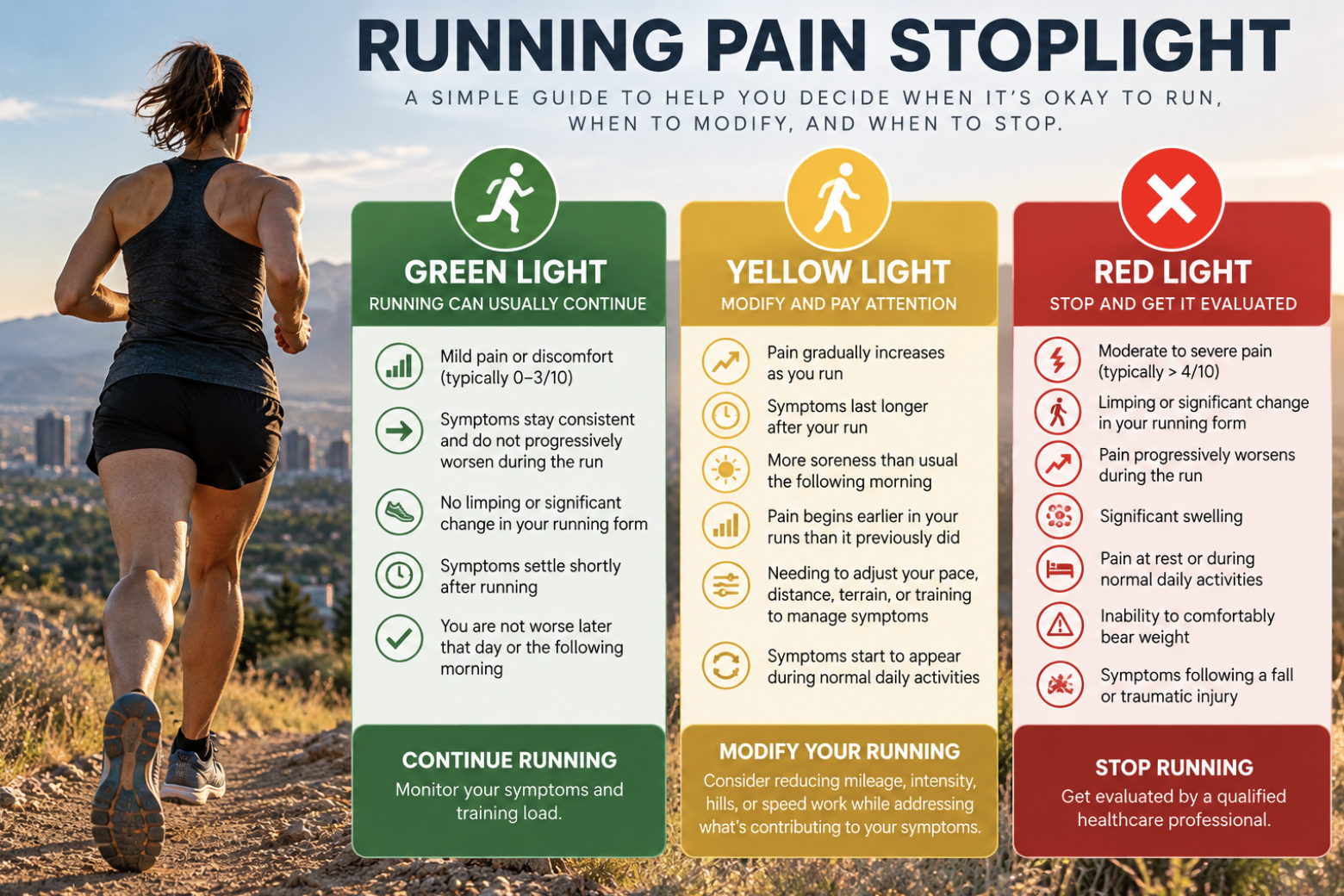
A simple way to think about this is with a stoplight system.
🟢 Green Light: Running Can Usually Continue
You're in the green-light zone when symptoms are mild and stable.
This may look like:
Mild discomfort that doesn't progressively worsen
Symptoms that stay consistent throughout the run
No limping or noticeable change in your running form
Symptoms settle shortly after running
You aren't worse later that day or the following morning
The important part isn't simply that the pain is “low.”
It's that your body appears to be tolerating the amount of running you're currently doing.
For example, a runner who experiences mild discomfort for the first few minutes that improves and has no increase in symptoms afterward may be in a very different situation than someone whose pain starts mild but progressively worsens with every mile.
Both runners might initially call their pain a 2/10.
The behavior of the symptoms tells us much more.
🟡 Yellow Light: Modify and Pay Attention
The yellow-light zone is where you need to be more cautious.
Your body may be telling you that your current running load is more than it can comfortably tolerate.
Signs you may be in the yellow zone include:
Pain gradually increasing as you run
Symptoms lasting longer after your run
More soreness than usual the following morning
Pain beginning earlier in your runs than it previously did
Symptoms appearing during normal daily activities
Needing to alter your pace, distance, terrain, or training to control symptoms
This doesn't automatically mean you need to stop running completely.
It may mean your training needs to be adjusted.
Depending on the situation, that could mean decreasing your mileage, reducing intensity, temporarily removing hills or speed work, adding more recovery between runs, or shortening individual runs.
The goal is to find a level of activity your body can tolerate while addressing what's contributing to the problem.
🔴 Red Light: Stop and Get It Evaluated
Some symptoms shouldn't be treated as normal running aches and pains.
I generally recommend stopping the run and getting evaluated when you experience things such as:
Pain severe enough that you're limping or significantly changing your running form
Sudden or severe pain
Significant swelling
Inability to comfortably bear weight
Progressive pain that continues worsening despite reducing your training
Pain that is consistently present at rest or during normal daily activities
Symptoms following a significant fall or traumatic injury
There are also certain injuries where continuing to run may not be appropriate even if the pain initially seems manageable.
This is one reason pain level alone isn't enough to determine whether running is safe.
If you're unsure what's causing your symptoms, an evaluation can help determine whether continuing to run is appropriate.
Why I Don't Use a Strict Pain Scale Rule
You've probably seen recommendations saying you can continue exercising as long as your pain stays below a certain number.
Pain scales can be useful, but they have limitations.
One person's 3/10 may be another person's 5/10. More importantly, two runners experiencing the exact same pain level may respond completely differently after running.
Instead of focusing exclusively on a number, I want to know:
Is the pain getting worse while you run?
Is it changing the way you run?
How quickly does it settle afterward?
Are you worse later that day?
How do you feel the following morning?
Those answers give us much more information about how well you're tolerating your current training.
Don't Forget About Training Load
If you've moved from the green zone into the yellow zone, one of the first questions I would ask is:
What changed?
Think about the few weeks before your symptoms started.
Did you increase your mileage? Add another running day? Start doing speed work? Add hills? Change your strength training? Start preparing for a race? Return to running after taking time off?
Sometimes there isn't one dramatic mistake.
Several small increases can add up to a significant change in the amount of stress you're placing on your body.
Your fitness may allow you to complete the workout, but that doesn't necessarily mean your body has adapted to that workload yet.
The Goal Isn't Always Complete Rest
When something hurts, it's tempting to stop running until the pain disappears completely.
Sometimes rest is necessary.
But for many running injuries, the better question is:
How much activity can you currently tolerate?
If appropriate for the injury, maintaining some running while adjusting your training can help you stay active while you work on the underlying problem.
Then, as your capacity improves, running can progressively increase again.
That's very different from repeatedly cycling between your normal training and complete rest every time symptoms return.
Use the Stoplight as a Guide, Not a Diagnosis
The stoplight system is a useful way to monitor how your body responds to running:
🟢 GREEN: Symptoms are mild, stable, don't change your running mechanics, and return to baseline afterward.
🟡 YELLOW: Symptoms are increasing, lasting longer, appearing earlier, or affecting your normal activity. Your training likely needs to be modified.
🔴 RED: Symptoms are severe, significantly affecting your movement, or concerning for an injury that needs evaluation. Stop running and get it assessed.
The important thing to remember is that this system doesn't tell you what injury you have.
Different injuries have different considerations, and there are situations where running should be stopped even when pain is relatively mild.
Not Sure If You Should Keep Running?
You shouldn't have to guess whether you're helping or hurting your recovery every time you go for a run.
At Stride Running PT, I work one-on-one with runners to determine what's contributing to their symptoms, what they can safely continue doing, and how to progressively return to the training they want to do.
And because Stride Running PT is mobile, I come to you.
If pain is interfering with your training, explore Physical Therapy at Stride Running PT to see how I can help you get back to running.
Disclaimer: This article is for educational purposes only and is not intended to provide medical advice, diagnosis, or treatment. The stoplight system is a general framework and may not be appropriate for every injury or medical condition. If you are experiencing pain or other symptoms, consult a qualified healthcare professional for an individual evaluation.