

Do Runners Really Need Strength Training?

If you want to become a better runner, the obvious answer seems to be: run more.
And to a point, that's true. Running is the most important part of becoming better at running.
But strength training can play an important role too.
For many runners, strength training gets pushed aside because they're worried about becoming bulky, making their legs too tired to run, or simply don't know what exercises are actually worth doing.
So what does strength training actually do for runners, and how much of it do you really need?
Why Strength Training Matters for Runners
Running requires your body to repeatedly absorb and produce ~6-8x your body weight in force.
During even a relatively short run, each leg has to handle that demand thousands of times.
Running itself builds some of the capacity needed to do this, but running and strength training don't provide exactly the same stimulus.
Strength training allows muscles and tendons to experience higher loads than they typically encounter during normal running.
Over time, that can improve your body's ability to produce and tolerate force.
For a runner, the goal isn't necessarily to lift the most weight possible.
It's to build a body that can handle the demands of the running you want to do.
Will Strength Training Make You a Faster Runner?
Potentially.
Strength training isn't a replacement for running workouts, but research has shown that certain types of strength training can improve running economy.
Running economy is essentially how much energy your body requires to maintain a given running speed.
Think of it like fuel economy in a car.
Two runners can be moving at the exact same pace, but one may require less energy to maintain it.
Heavy resistance training and explosive training have both been studied as ways of improving running economy without necessarily increasing a runner's body weight.
That doesn't mean every runner needs to train like a powerlifter.
It means strength can be another piece of improving running performance.
Can Strength Training Prevent Running Injuries?
This is where things get more complicated.
There isn't one exercise—or even one strength program—that can guarantee a runner won't get injured.
Running injuries are multifactorial and often unavoidable.
Training load, previous injuries, recovery, sleep, strength, nutrition, running mechanics, and many other factors can all play a role.
Strength training can improve the capacity of muscles and tendons to tolerate load, which can be valuable for runners.
But it shouldn't be viewed as an injury-proofing program.
A runner can have incredibly strong legs and still get injured if their overall training demands exceed what their body can tolerate.
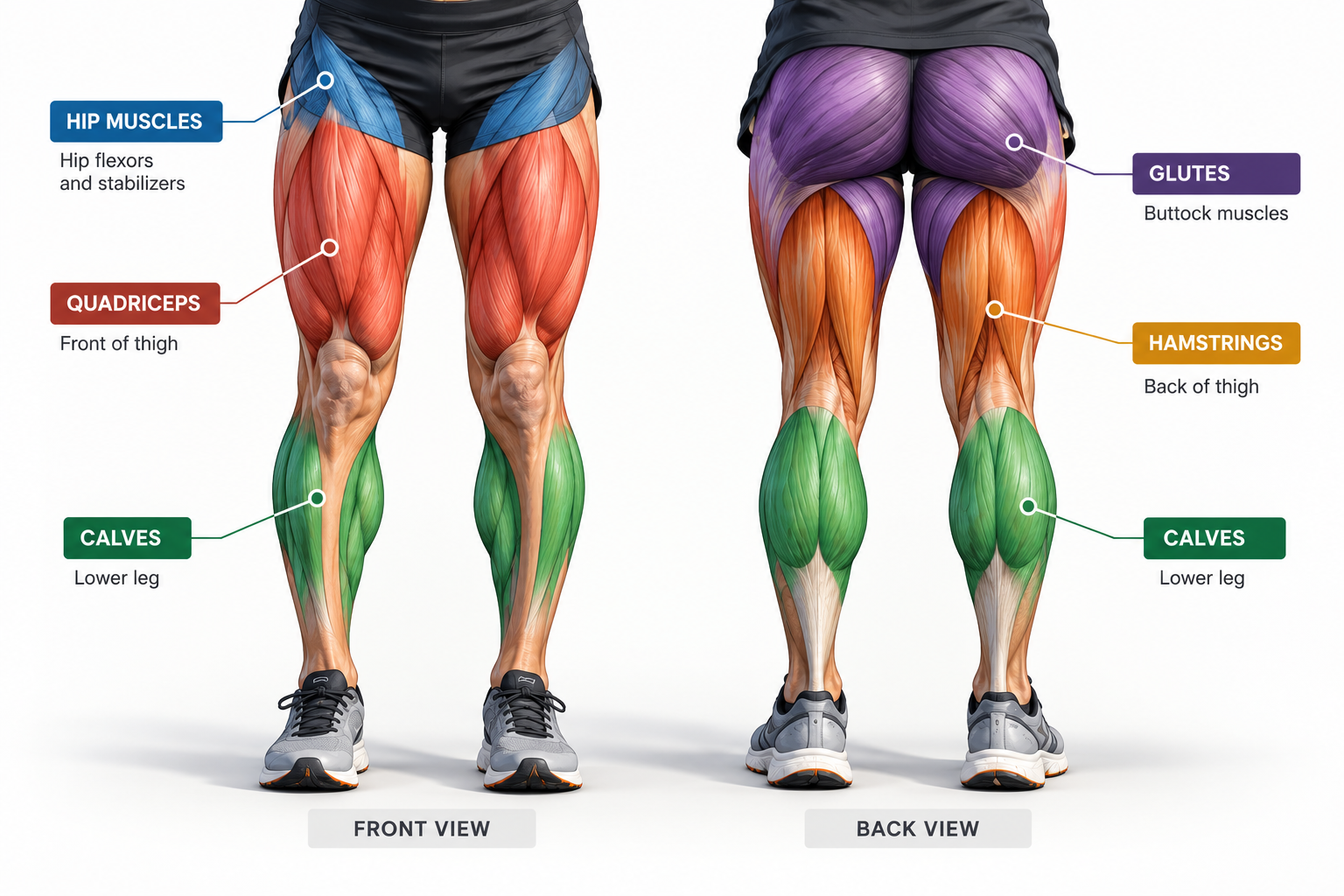
What Muscles Should Runners Strengthen?
Running is a full lower-body activity, so a runner's strength program shouldn't focus on only one muscle group.
Important areas commonly include the:
Calves
Quadriceps
Hamstrings
Glutes
Hips
Feet and ankles
Core and trunk strength can also be incorporated depending on the runner and their goals.
One mistake runners sometimes make is focusing almost entirely on the hips and glutes while neglecting the rest of the leg.
Your calves, for example, handle a tremendous amount of work while running.
A well-rounded program should reflect the demands placed across the entire lower extremity.
What Exercises Are Best for Runners?
There isn't one perfect set of exercises for every runner.
But effective running strength programs commonly include movements such as:
Squats
Split squats or lunges
Step-ups
Deadlift variations
Calf raises
Single-leg exercises
Hamstring strengthening
Hopping or jumping exercises when appropriate
The exact exercise matters less than whether it is appropriately challenging and progresses over time.
Doing the same set of easy exercises indefinitely isn't much different than running the exact same distance at the exact same pace forever and expecting to continuously improve.
Your body adapts to what you ask it to do.
Strength training needs progression too.
Do Runners Need Heavy Weights?
This is one of the biggest misconceptions I see with runners.
Many runners perform strength exercises with very light resistance for a large number of repetitions because it feels more specific to endurance running.
But you're already getting a tremendous amount of endurance work from running.
Strength training gives you an opportunity to provide a different stimulus.
As a runner becomes comfortable with resistance training and develops good technique, heavier resistance can be used to challenge strength without requiring extremely high repetition counts.
“Heavy” is also relative.
It doesn't mean every runner needs to put a barbell on their back and attempt a maximum squat.
It simply means the exercise needs to be sufficiently challenging for that individual.
Will Lifting Weights Make Runners Bulky?
This is a common concern, particularly for runners focused on performance.
Significant muscle growth generally requires a combination of sufficient training volume, resistance, nutrition, and time.
Adding strength training to an endurance-running program doesn't automatically result in large increases in muscle mass.
And the goal of a runner's strength program can be structured very differently from a bodybuilding program designed specifically to maximize muscle growth.
How Often Do Runners Strength Train?
There isn't one schedule that works for everyone.
The right amount depends on the runner's experience, running volume, current training phase, injury history, and goals.
A runner preparing for a marathon and running six days per week has a very different training schedule than someone running three days per week for general fitness.
The bigger consideration is how all of your training fits together.
Running mileage, workouts, long runs, strength sessions, and recovery all contribute to your total workload.
More isn't automatically better.
The strength program needs to complement the running program rather than constantly interfering with it.
Where Should Strength Training Fit Into Your Running Week?
This is often more important than choosing the “perfect” exercises.
If you perform a difficult leg workout the day before your hardest running workout, your legs may still be fatigued when it's time to run.
On the other hand, spreading every difficult session across separate days can leave you training hard almost every day of the week with very little true recovery.
There are several ways to organize running and strength training successfully.
The best setup depends on which workouts are most important, how frequently you're running, and how well you recover between sessions.
The goal is to look at the entire training week, not strength training and running as two completely separate programs.
Strength Training Should Support Your Running
You don't need to become a weightlifter to benefit from getting stronger.
And you don't need an overly complicated collection of “runner-specific” exercises.
Strength training is simply another tool.
Used appropriately, it can improve your ability to produce and tolerate force and may contribute to better running performance.
The important part is making sure your strength program actually supports what you're trying to accomplish as a runner.
Want to Improve Your Running Beyond Just Adding More Miles?
Stride Running PT works with runners throughout the Denver area who want to better understand their strength, movement, and running performance.
A Running Performance Assessment looks beyond simply watching you run. We'll assess your running, strength, mobility, and other factors relevant to your individual goals.
And because Stride Running PT is mobile, I come to you.
Disclaimer: This article is for educational purposes only and is not intended to provide individualized medical, rehabilitation, or training advice. Individual needs vary based on health, injury history, training experience, and goals.