

Is Heel Striking Bad for Runners?

If you've spent any time researching running form, you've probably heard some version of this:
“Heel striking is bad. You should land on your midfoot or forefoot.”
It's one of the most persistent pieces of running advice.
Look at the slow-motion video of many elite runners and you'll see the heel contact the ground first. For years, runners have been told this increases impact, causes injuries, and makes them less efficient.
But foot strike is only one small part of running mechanics, and simply changing where your foot contacts the ground doesn't automatically make you a better—or healthier—runner.
So, is heel striking actually bad?
What Is a Heel Strike?
Foot strike describes which part of your foot initially contacts the ground while running.
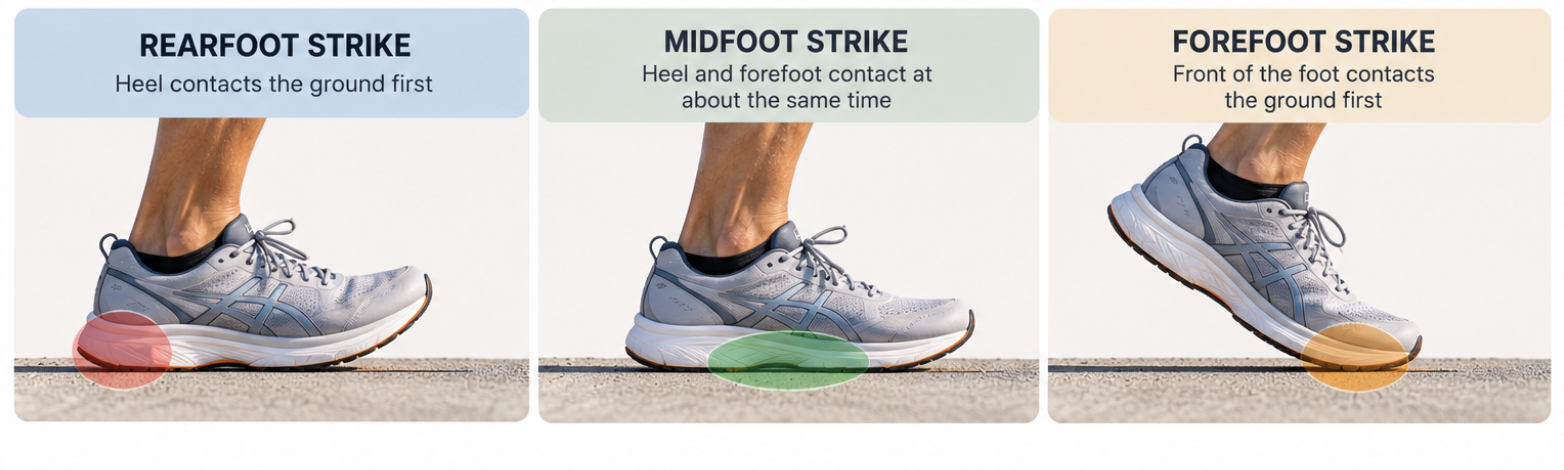
It's generally divided into three categories:
Rearfoot (heel) strike: The heel contacts the ground first.
Midfoot strike: The heel and forefoot contact the ground at approximately the same time.
Forefoot strike: The front portion of the foot contacts the ground before the heel.
These categories are useful for describing what we see, but they don't tell us whether someone is running well or poorly.
Two runners can both heel strike and have completely different running mechanics.
Heel Striking Is Common
Heel striking isn't an unusual running pattern.
Many recreational distance runners naturally land with a rearfoot strike.
That alone isn't necessarily a problem.
Your body has multiple ways of absorbing force when you run, and changing your foot strike primarily changes where some of those forces are distributed.
That's an important distinction.
Switching from a heel strike to a forefoot strike doesn't make impact disappear.
It changes how your body manages it.
Changing Your Foot Strike Changes Where the Load Goes
One reason I don't look at foot strike in isolation is because changing it affects other parts of the body.
A more rearfoot-dominant running pattern may place different demands on the knee compared with a more forefoot-dominant pattern.
A forefoot strike generally places greater demands on the ankle and calf complex.
Neither is automatically good or bad.
They're simply different strategies.
This becomes particularly important when someone suddenly changes their running form.
If you've spent years heel striking and suddenly try to run exclusively on your forefoot, your calves and Achilles tendon may be exposed to significantly different demands than they're accustomed to.
Your body needs time to adapt to changes in load just like it needs time to adapt when you increase your mileage.
What Matters More Than Where Your Foot Lands?
Instead of asking only:
“Am I heel striking?”
A more useful question is:
“What is the rest of my body doing when my foot hits the ground?”
For example, I may look at:
Where the foot lands relative to the body
Cadence
Step length
Knee position
Hip movement
Trunk position
Vertical movement
Differences between the right and left sides
Foot strike is part of the picture.
It just isn't the entire picture.
Heel Striking and Overstriding Aren't the Same Thing
These two terms are often treated as though they mean the same thing.
They don't.
Heel striking describes which part of your foot contacts the ground first.
Overstriding describes how your leg and foot are positioned relative to your body when you contact the ground.
A runner can heel strike without significantly overstriding.
That's why looking at a freeze-frame of someone's foot hitting the ground doesn't tell you everything you need to know about their running form.
Running is a movement, not a photograph.
Should Every Runner Increase Their Cadence?
Cadence is another common recommendation that often comes up when discussing heel striking.
You'll sometimes hear that every runner should aim for 180 steps per minute.
There isn't one ideal cadence that applies to every runner.
Cadence naturally changes based on factors such as running speed, height, leg length, experience, and individual mechanics.
Changing cadence can be a useful tool in certain situations, but the goal isn't to force every runner toward the same number.
Just like foot strike, cadence should be considered in the context of the runner as a whole.
Should You Change Your Foot Strike?
Seeing that you heel strike isn't, by itself, a reason to change it.
Changing running mechanics makes the most sense when there's a reason behind the change.
For example, a physical therapist or running professional may look at running mechanics as part of a larger assessment when someone is experiencing pain or when a runner is trying to address a specific performance issue.
Even then, changing foot strike may or may not be part of the approach.
The question shouldn't be:
“How do I stop heel striking?”
It should be:
“Is there actually a reason I need to change the way I'm running?”
There's No Single Perfect Running Form
Watch a group of successful runners and you'll see plenty of differences.
Different foot strikes.
Different cadences.
Different arm movements.
Different amounts of hip, knee, and ankle motion.
Humans aren't built identically, and we shouldn't expect every runner to look identical either.
Running mechanics matter, but the goal of a running assessment shouldn't be to make everyone fit the same picture of “perfect form.”
It's to understand how you run, how your body handles the demands of running, and whether anything you're doing is relevant to the problem or goal you're trying to address.
Curious About Your Running Form?
Watching yourself run in slow motion can be interesting.
But identifying a heel strike, a certain cadence, or another characteristic doesn't necessarily tell you whether it needs to change.
At Stride Running PT, the Running Performance Assessment looks at your running mechanics along with your strength, mobility, training, and individual goals to give you a more complete picture of your running.
And because Stride Running PT is mobile, I come to you.
Disclaimer: This article is for educational purposes only and is not intended to provide individualized medical, rehabilitation, or training advice. Running mechanics and appropriate training strategies vary between individuals.