

Foot pain can be incredibly frustrating for runners.
Sometimes it starts as a mild ache during the first mile. Other times, you finish a run feeling completely fine, only to notice pain when you get out of bed the next morning.
You might feel it in your heel, along your arch, on the top of your foot, or near your toes.
And while it's tempting to blame your running shoes, the location of your symptoms and how they behave can tell us much more about what might be happening.
Not all foot pain in runners comes from the same structure, and not all foot pain should be treated the same way.
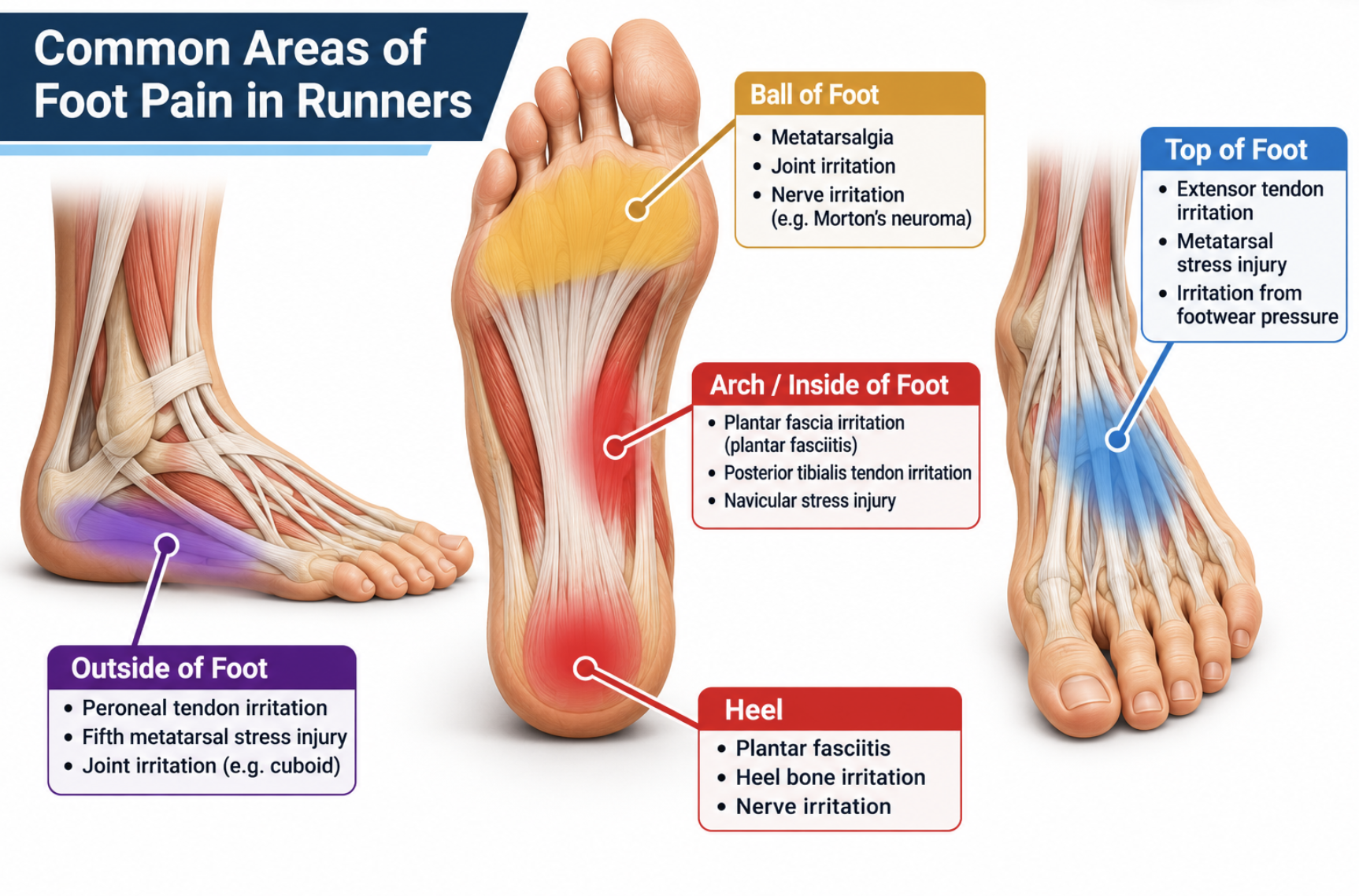
Where Is Your Foot Pain Located?
One of the first questions I ask runners experiencing foot pain is exactly where they're feeling it.
Your foot contains numerous bones, joints, muscles, tendons, and ligaments that work together to absorb and transfer forces during running.
Different structures can produce pain in different locations, although symptoms can overlap.
Pain Under the Heel or Along the Arch
Pain underneath the heel or along the inside of the arch is commonly associated with plantar heel pain, often called plantar fasciitis.
The plantar fascia is a thick band of connective tissue that helps support the arch and contributes to the foot's ability to handle loading.
Runners with plantar heel pain may notice:
Pain with their first steps in the morning
Discomfort after sitting for an extended period
Symptoms that improve after walking for a few minutes
Pain that returns after longer periods of activity
However, not all heel pain is caused by the plantar fascia. Other conditions, including nerve irritation and bone stress injuries, can produce symptoms in a similar area.
Pain on the Top of the Foot
Pain across the top of the foot can have several causes.
Tendons that help lift your toes and ankle run along this area and may become irritated with repetitive loading or pressure from footwear.
But pain on the top of the foot can also be associated with metatarsal bone stress injuries.
This distinction is particularly important.
A runner with a bone stress injury may initially notice discomfort only during longer runs. As the condition progresses, symptoms may begin earlier or appear during walking.
Localized tenderness over a bone, swelling, or pain with weight-bearing warrants medical evaluation rather than assuming the problem is simply a tight shoe.
Pain Along the Inside of the Foot or Ankle
The posterior tibialis tendon runs behind the inside of the ankle and attaches to several structures in the foot.
It plays an important role in supporting and controlling the foot during movement.
Irritation of this tendon may cause pain along the inside of the ankle or arch, particularly with running or other weight-bearing activities.
However, pain around the inner arch or midfoot can also involve the navicular bone.
Navicular bone stress injuries are especially important not to overlook in runners, because delayed recognition can complicate recovery.
Pain Along the Outside of the Foot
Pain along the outside of the foot may involve the peroneal tendons, which help control the foot and ankle during movement.
Other potential causes include irritation of the joints or a bone stress injury involving the fifth metatarsal.
The exact location, symptom behavior, and clinical examination help distinguish between these possibilities.
Pain Near the Ball of the Foot
Pain beneath the toes or across the ball of the foot is often described as metatarsalgia.
This term describes a symptom location rather than one specific diagnosis.
Possible contributors include irritation of the metatarsophalangeal joints, surrounding soft tissues, or nerves.
Some runners notice symptoms during faster running or when wearing shoes with a narrower toe box.
Because several structures are located close together, a thorough evaluation can be helpful when symptoms persist.
Why Does Foot Pain Develop When Running?
Your feet are responsible for handling thousands of loading cycles during a typical run.
They help absorb forces, provide stability, and contribute to propulsion.
When the demands placed on a particular tissue exceed what it can currently tolerate, symptoms may develop.
But that doesn't automatically mean something is wrong with your running form.
Several factors can contribute.
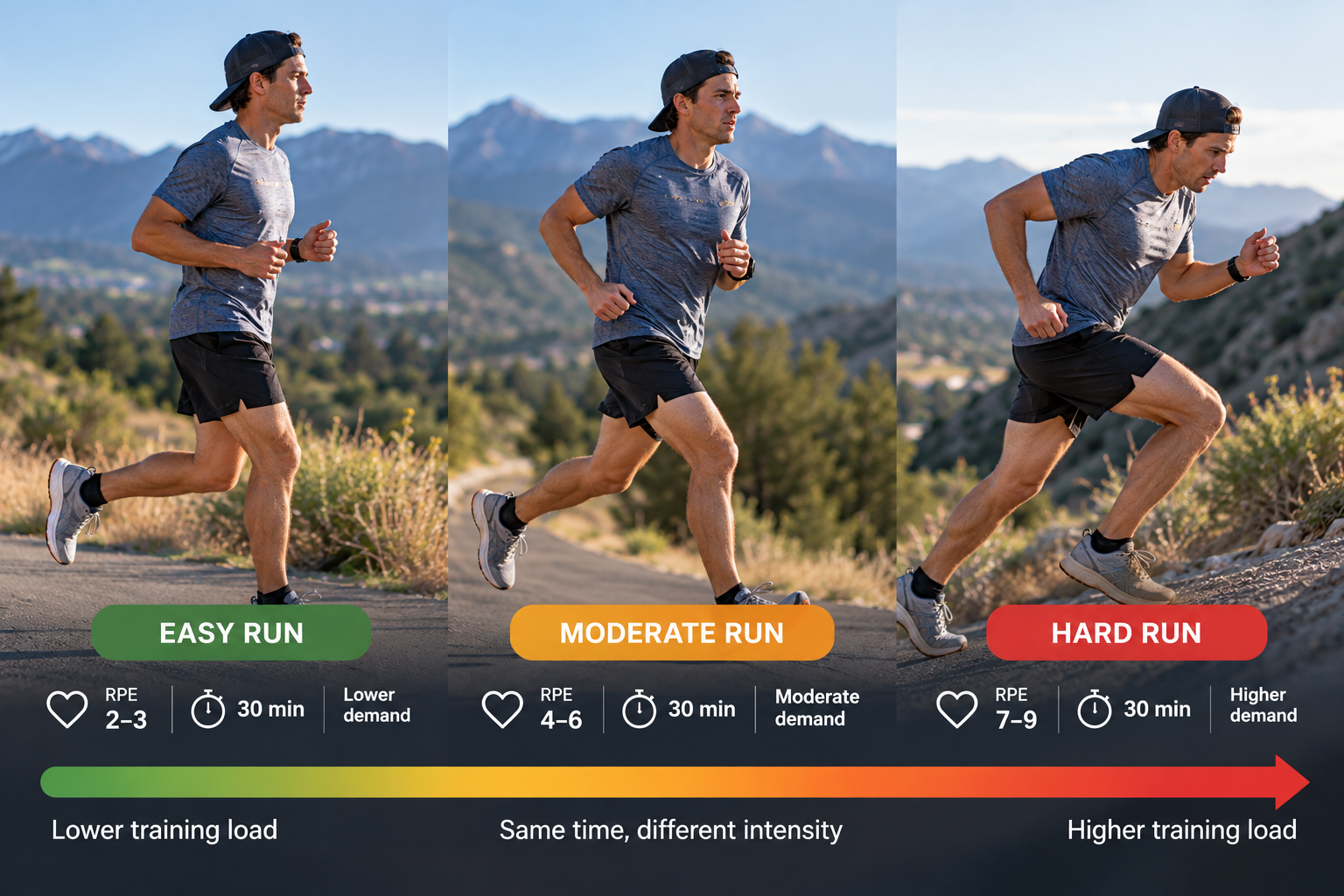
Training Load Matters More Than Most Runners Realize
One of the first things I ask when evaluating a running injury is what changed before the pain started.
Did you increase your mileage?
Start running more frequently?
Add speed workouts?
Begin training on hills?
Return from a break?
Sometimes runners tell me their mileage hasn't changed, so they don't understand why they're suddenly having pain.
But mileage is only one part of training load.
Running faster, adding hill workouts, or increasing the number of challenging sessions can change the demands placed on your feet.
Two weeks with identical mileage can place very different demands on your body.
This is why understanding your training history is often just as important as examining the painful area.
Are Your Running Shoes Causing Your Foot Pain?
Running shoes are often the first thing people blame when foot pain develops.
And sometimes footwear is relevant.
For example, if you recently switched to a significantly different shoe and began experiencing symptoms shortly afterward, that change is worth considering.
Different shoes can alter how forces are distributed throughout the foot and lower extremity.
A narrower toe box may also aggravate certain forefoot symptoms.
Similarly, a shoe that has become uncomfortable or worn may no longer feel appropriate for that runner.
But there's an important distinction between a shoe contributing to symptoms and a shoe being the underlying cause of an injury.
Most running injuries can't be explained simply by choosing the wrong shoe.
Your training demands, tissue capacity, injury history, and individual biomechanics often matter more than the specific model of shoe you're wearing.
I generally don't recommend changing shoes solely because someone develops foot pain without first understanding what's causing it.
Does Having Flat Feet Mean You're More Likely to Get Injured?
Another common concern is foot posture.
Runners often worry that their arches are too low or that their feet pronate too much.
But pronation is a normal part of running.
Your foot needs to move and adapt as it contacts the ground.
Having a lower arch doesn't automatically mean you're running incorrectly or that you're destined to develop an injury.
Likewise, having a high arch doesn't guarantee you'll avoid problems.
Foot posture may be relevant in certain situations, but it's only one part of a much larger picture.
The goal isn't to make every runner's feet look identical. It's to understand whether their individual mechanics are relevant to their symptoms.
Should You Stretch Your Foot If It Hurts?
Stretching is often one of the first things runners try when they develop foot pain.
But whether stretching is helpful depends on what structure is involved.
For some presentations of plantar heel pain, targeted stretching may provide symptom relief.
For other conditions, particularly certain tendon problems or bone stress injuries, aggressive stretching may be unhelpful or inappropriate.
Feeling tight doesn't automatically mean the tissue needs to be stretched.
Sometimes a sensation of tightness is related to irritation rather than an actual mobility restriction.
This is why I generally prefer identifying the likely source of symptoms before deciding whether stretching should be part of treatment.
Why Foot Strength Matters for Runners
Your foot contains small intrinsic muscles as well as larger muscles that originate in the lower leg.
Together, these muscles contribute to controlling movement, supporting the arch, and managing forces during running.
Strength deficits may be relevant for certain foot and ankle problems.
But strengthening isn't simply about doing towel scrunches or picking up marbles with your toes.
Depending on the injury, rehabilitation may need to address the calf muscles, foot muscles, single-leg control, and eventually the ability to tolerate repeated impact.
And just like any other area of the body, the exercises should progress toward the demands of the activity you're trying to return to.
The goal isn't just to strengthen your foot. It's to build the capacity needed for running.
Can You Keep Running With Foot Pain?
Sometimes, but it depends on the cause.
Certain muscle or tendon-related conditions may allow for modified running while symptoms are managed.
However, suspected bone stress injuries require a different approach.
Continuing to run on a bone stress injury can allow the condition to progress, potentially leading to a fracture or prolonged recovery.
I would be particularly concerned about symptoms such as:
Focal pain directly over a bone
Swelling in a specific area
Pain that increases with weight-bearing
Limping or changes in walking mechanics
Pain that progresses from running into normal daily activities
These symptoms warrant medical evaluation, especially when a bone stress injury is possible.
For other presentations, how your symptoms respond during activity, afterward, and the following day can provide useful information.
I discuss this further in my article "How Much Pain Is Okay to Run Through? The Stoplight Guide for Runners."
Why Rest Alone May Not Solve Your Foot Pain
Taking time away from running may help symptoms improve because you're reducing the demands on the irritated tissue.
But depending on the condition, feeling better after rest doesn't necessarily mean the foot is ready for your previous training.
For example, a runner with a load-related tendon problem may feel significantly better after several weeks off.
However, immediately returning to the same mileage and intensity may reproduce the symptoms.
A more complete rehabilitation approach may involve gradually restoring strength, rebuilding tolerance to loading, and progressing back toward running.
For some conditions, particularly bone stress injuries, an initial period of protection or restricted activity is essential before progressive loading begins.
The goal isn't simply to eliminate pain. It's to restore the ability to tolerate the demands of running safely.
What Does Physical Therapy for Foot Pain Look Like?
A running-focused physical therapy assessment should involve more than looking at where your foot hurts.
Depending on your symptoms, I may evaluate:
The exact location and behavior of your pain
Recent changes in training volume and intensity
Foot and ankle strength
Mobility
Single-leg balance and control
Running mechanics
Footwear history
Previous injuries and running goals
These findings help determine whether the problem is likely related to a muscle, tendon, joint, bone, or another structure.
They also help identify when additional medical evaluation or imaging may be necessary.
Treatment can then be tailored to the condition rather than relying on the same stretches or exercises for every runner.
Foot Pain Keeping You From Running?
If foot pain is interfering with your training, understanding what's causing it is the first step toward getting back to running.
At Stride Running PT, I provide running-focused physical therapy that looks beyond the painful area.
I evaluate strength, mobility, running mechanics, training demands, and your individual goals to help develop a plan for returning to running.
And because Stride Running PT is mobile, I come to you, serving runners throughout Littleton, Denver, and surrounding communities.
Whether you're preparing for a race or simply trying to get back to your normal routine, the goal is to help you return to consistent running.
Book a Call to learn more about running-focused physical therapy.
Disclaimer: This article is for educational purposes only and is not intended to provide medical advice, diagnosis, treatment, or individualized recommendations. Foot pain can have multiple causes, including bone stress injuries that require medical evaluation and activity modification. Persistent or worsening pain, localized bony tenderness, swelling, or pain with weight-bearing should be evaluated by a qualified healthcare professional.