


Hip pain can be especially frustrating for runners because it doesn't always show up in the same place.
Some runners experience pain on the outside of their hip. Others feel discomfort in the front of the hip or deep in the groin. Some notice pain in their glutes or toward the back of the pelvis.
And while it's tempting to assume hip pain means you have tight hip flexors or weak glutes, the location of your symptoms can provide important clues about what might be happening.
Not all hip pain in runners comes from the same structure, and not all hip pain should be treated the same way.
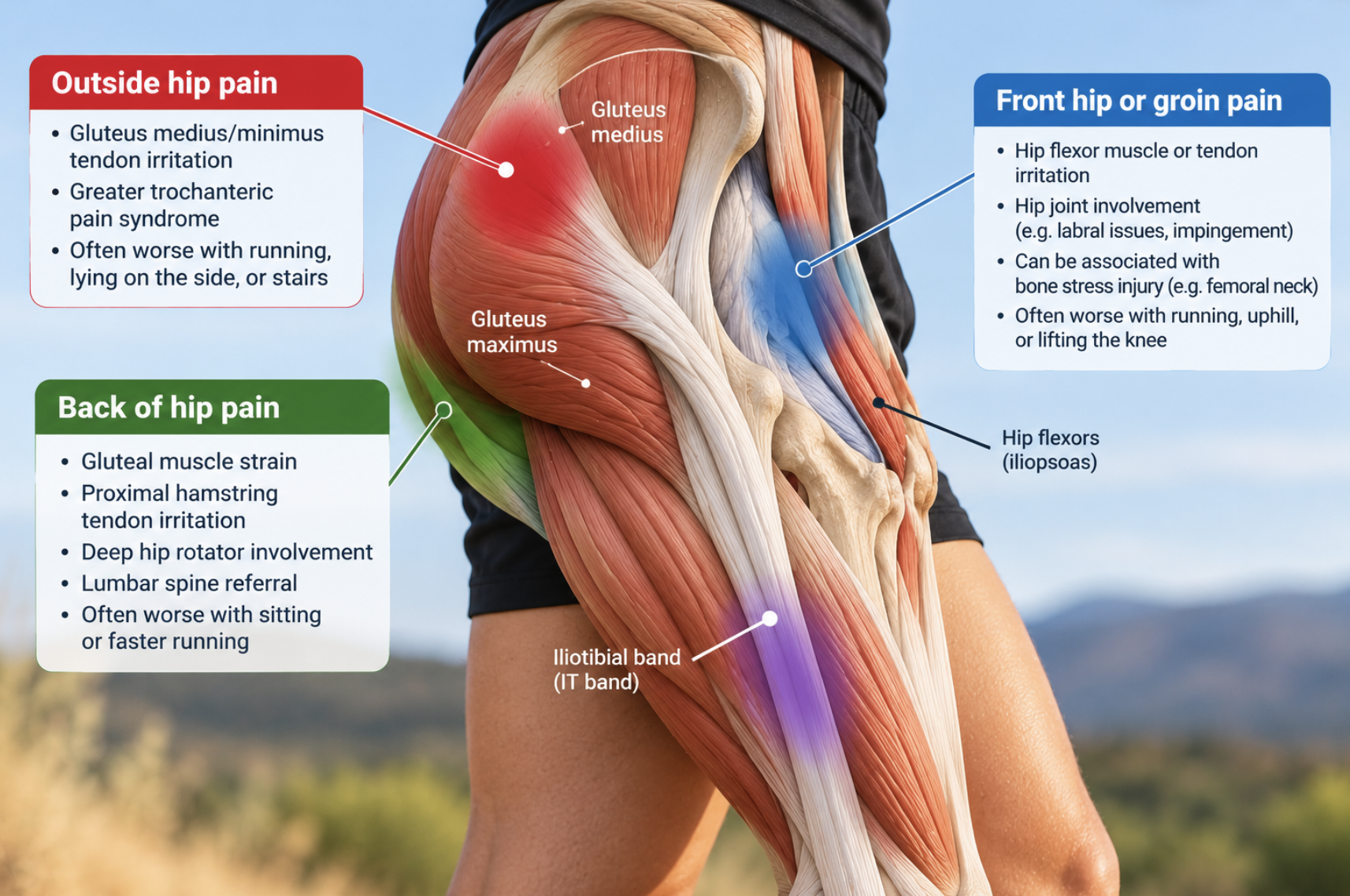
Where Is Your Hip Pain Located?
One of the first things I want to know when evaluating a runner with hip pain is exactly where they're feeling it.
Although symptoms can overlap, different locations may point toward different potential causes.
Pain on the Outside of the Hip
Pain along the outside of the hip is commonly associated with irritation of the gluteal tendons, particularly the gluteus medius and minimus.
These tendons help transfer forces and stabilize the pelvis during activities like walking and running.
Runners with gluteal tendon pain may notice discomfort when:
Running, particularly with increased training demands
Lying on the painful side
Standing on one leg
Walking uphill or climbing stairs
Sitting with their legs crossed
This is sometimes described as greater trochanteric pain syndrome.
However, pain in this region can have other causes, so location alone isn't enough to establish a diagnosis.
Pain in the Front of the Hip or Groin
Pain toward the front of the hip can come from several structures.
Potential contributors include the hip flexor muscles and tendons, the hip joint itself, or other surrounding tissues.
Some runners experience symptoms when lifting their knee, accelerating, or running uphill.
Others notice discomfort with deeper hip flexion, such as squatting or sitting for extended periods.
Hip joint conditions, including femoroacetabular impingement-related symptoms and labral pathology, can sometimes contribute to groin pain.
But imaging findings don't always explain symptoms. Some people have structural changes in their hips without experiencing pain.
Importantly, groin pain in a runner can also be associated with a femoral neck bone stress injury, which requires prompt medical assessment rather than simply stretching or continuing to train.
Pain in the Back of the Hip or Glutes
Pain in the posterior hip may involve the gluteal muscles, proximal hamstring tendon, lumbar spine, or other structures around the pelvis.
Some runners experience pain during faster running or uphill efforts.
Others notice discomfort when sitting or bending forward.
Because the hip, pelvis, and lower back are closely connected, symptoms in this area aren't always coming directly from the hip.
A complete assessment helps distinguish between these possibilities.
Why Does Hip Pain Start When Running?
Running repeatedly places demands on the muscles, tendons, bones, and joints around the hip.
Your hip muscles do much more than move your leg forward and backward.
They help control your pelvis, support your body during single-leg stance, and manage forces throughout each stride.
When running demands exceed what a particular tissue can tolerate, symptoms may develop.
But that doesn't automatically mean the tissue is weak.
There are several factors worth considering.
Changes in Training Load
One of the first things I ask runners about is what changed before their symptoms started.
Did you increase your mileage?
Add speed workouts?
Start running more hills?
Increase the number of days you're running?
Return from time off?
Sometimes the change seems relatively small.
For example, a runner may maintain the same weekly mileage but replace two easy runs with harder workouts.
Their mileage hasn't changed, but the demands on their body have.
Training intensity matters just as much as the number of miles you're running.
Understanding recent changes often provides more useful information than simply looking for one muscle that's supposedly too tight or weak.
Are Weak Glutes Causing Your Hip Pain?
You've probably heard that runners develop hip pain because their glutes aren't strong enough.
There can be some truth to this, but it's an oversimplification.
The gluteal muscles play an important role in running, and strength deficits may contribute to certain problems.
However, not every runner with hip pain has weak glutes.
And not every runner with weak glutes develops hip pain.
Some runners have adequate strength but increase their training beyond what their tissues are currently prepared to tolerate.
Others may have strength or movement deficits that are relevant to their symptoms.
This is why I prefer assessing strength rather than assuming weakness based on where someone hurts.
Strength training can be an important part of treatment, but it should address the individual runner's needs.
Should You Stretch a Painful Hip?
Stretching is often one of the first things runners try when their hip starts hurting.
It makes sense. The area feels tight, so stretching seems like the obvious solution.
But feeling tight doesn't necessarily mean a muscle is actually shortened.
Sometimes a painful or irritated tissue creates a sensation of tightness even when mobility is normal.
And certain conditions may become more irritated with aggressive stretching.
For example, runners with gluteal tendon pain may experience increased symptoms when stretching into positions that compress the tendons along the outside of the hip.
Similarly, aggressively stretching an irritated hip flexor may not be particularly helpful if the primary problem is its ability to tolerate loading.
That's not to say stretching is always bad.
If someone has a meaningful mobility restriction, addressing it may be appropriate.
But I generally don't recommend stretching simply because an area hurts or feels tight without understanding why.
Can Running Form Cause Hip Pain?
Running mechanics can influence how forces are distributed throughout the body.
Things like step width, cadence, pelvic movement, and trunk position may affect loading around the hip.
But identifying an unusual movement pattern doesn't automatically mean you've found the cause of someone's pain.
Some runners have noticeable pelvic drop or hip adduction and never develop symptoms.
Others demonstrate relatively typical mechanics but still experience hip pain.
A running gait analysis can help identify movement patterns that may be worth considering, particularly when combined with strength testing and a review of training history.
The important question isn't whether your running looks perfect.
It's whether a particular movement pattern is relevant to your symptoms and whether changing it is likely to help.
Can You Keep Running With Hip Pain?
That depends on the likely cause and how your symptoms behave.
Some muscle or tendon-related conditions may allow for modified running while the runner works on rebuilding capacity.
Others require more substantial activity restrictions.
Bone stress injuries are an important exception. Continuing to run with a suspected femoral neck stress injury can lead to serious complications.
Deep groin pain, pain with weight-bearing, limping, or symptoms that are progressing despite reduced activity warrant medical evaluation, particularly when a bone stress injury is possible.
For less concerning presentations, symptom behavior still matters.
Pay attention to whether pain:
Progressively worsens throughout your run
Causes you to change your stride
Appears earlier during successive runs
Persists or worsens afterward
Interferes with walking or normal daily activities
These patterns may indicate that your current running demands need to change.
I discuss symptom monitoring further in my article, "How Much Pain Is Okay to Run Through? The Stoplight Guide for Runners."
Why Rest Alone May Not Solve Hip Pain
Taking time away from running may reduce symptoms because you're removing the activity that irritates the tissue.
But depending on the condition, rest alone may not address the underlying issue.
For example, if a runner has a load-related tendon problem, they may feel better after several weeks off.
However, returning immediately to their previous mileage and intensity can reproduce the same symptoms.
A more complete rehabilitation approach may involve gradually restoring strength, improving tolerance to loading, and progressing toward the specific demands of running.
The goal isn't simply to eliminate pain during rest.
It's to rebuild the capacity needed to run consistently.
Of course, some injuries require an initial period of protection or restricted weight-bearing. This is why identifying the condition matters before deciding how to progress.
What Does Physical Therapy for Hip Pain Look Like?
A running-focused physical therapy assessment should involve more than identifying where your hip hurts.
Depending on your symptoms, I may evaluate:
The location and behavior of your pain
Recent changes in running volume and intensity
Hip strength and mobility
Single-leg balance and control
Running mechanics
Relevant movements that reproduce symptoms
Your training history and goals
The findings help determine whether your symptoms are more consistent with a muscle, tendon, joint, or other problem, and whether additional medical evaluation is needed.
Treatment may involve progressive strengthening, modifications to running demands, mobility work when appropriate, and a gradual return to higher-level activity.
There isn't one universal exercise or stretch that fixes every type of hip pain.
Hip Pain Keeping You From Running?
If hip pain is limiting your training, understanding what's causing it is the first step toward getting back to running.
At Stride Running PT, I provide running-focused physical therapy that evaluates more than just the painful area.
I look at strength, mobility, running mechanics, training demands, and your individual goals to help develop a plan for returning to running.
And because Stride Running PT is mobile, I come to you, serving runners throughout Littleton, Denver, and surrounding communities.
Whether you're trying to get back to your normal training or preparing for an upcoming race, the goal is to help you return to consistent running.
Book a Call to learn more about running-focused physical therapy.
Disclaimer: This article is for educational purposes only and is not intended to provide medical advice, diagnosis, treatment, or individualized recommendations. Hip pain can have multiple causes, including bone stress injuries requiring prompt medical evaluation. Persistent or worsening pain, limping, or pain with weight-bearing should be assessed by a qualified healthcare professional.